Developing story: the US decision was announced on 2 November and South Africa's response is still unfolding. This follows our earlier report that Washington was expected to announce South Africa's AGOA eligibility for 2027.
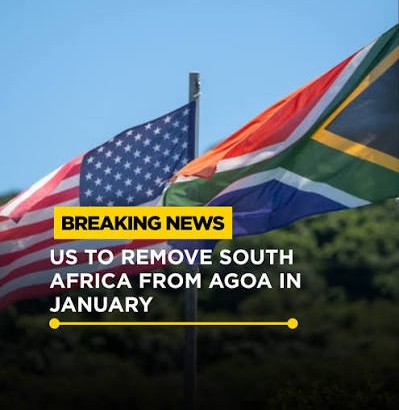
The United States says it will end South Africa's duty-free access under the African Growth and Opportunity Act (AGOA) from 1 January 2027, saying the country has engaged in practices inconsistent with the programme's eligibility criteria.
US Trade Representative Jamieson Greer announced the decision on Monday, 2 November. Rwanda is also affected. The South African government says it is assessing the consequences and that the US has raised new issues late in the negotiations.
What Washington says
Greer said South Africa was being removed for "engaging in practices that are inconsistent with Agoa's eligibility criteria", and that the administration was "deeply concerned by barriers to US trade and investment, corruption, and threats to US national security and foreign policy interests".
A letter to President Cyril Ramaphosa, reported to be dated 28 October, says South Africa has not established, or is not making continual progress toward, a system to combat corruption and bribery, and that it maintains significant tariff and non-tariff barriers. It adds that the US will keep monitoring whether South Africa makes progress. The letter reportedly names agricultural market access, regulatory requirements, investment protections and intellectual property among its concerns, but does not say which corruption cases it means.
US ambassador Leo Brent Bozell III said it was regrettable that South African policies led to the termination, and said he remained hopeful of "a path forward".
Pretoria's response
The Department of Trade, Industry and Competition said government recognised the concern the decision may cause for workers, exporters, businesses and communities. It said South Africa had offered concessions beyond 2015 while protecting its constitutional obligations, biosecurity and World Trade Organization commitments, and that it was "unfortunate that the US is now raising new issues".
Trade, Industry and Competition Minister Parks Tau said AGOA "remains important" but "does not constitute the totality of the economic relationship", and that the decision does not define the broader relationship with the US. He said a solution depends on both parties being willing to find one. Government says it will support affected firms company by company, keep talking to Washington and look to markets including the African Continental Free Trade Area, India, China, the EU, the UK and South-East Asia.
Who is exposed
Figures cited in reports show AGOA covered about 28% of South Africa's exports to the US in 2024, worth roughly $4bn, falling to about 10%, or roughly $1.7bn, in 2025. Total bilateral trade was reported at $28.8bn in 2025.
The Citrus Growers' Association says citrus faces ordinary US duties, and mandarins, lemons and grapefruit would also face an existing 12.5% tariff on citrus other than oranges. Chairperson Gerrit van der Merwe said entire orchards were planted specifically for the US market. Agricultural economist Wandile Sihlobo, Ramaphosa's agriculture envoy, estimated the change adds about 3.4 percentage points of tariff, taking some products from 12.5% to 15.9%.
Independent economist Eckart Naumann said the loss does not spell doom, because most exports to the US are minerals and metals that do not carry duty, and vehicles, steel and aluminium already face higher special tariffs. Cosatu has warned of job losses at factories in the Western Cape, while the DA called the decision a devastating blow to the economy.
What we do not yet know
- Whether the 60-day period mentioned in reports is a notice or an appeal window, and what process could reverse the decision before 1 January.
- How many jobs are at risk. The citrus industry says it is too early to say.
- The effect on vehicle exports, which sources describe differently.
- Whether the US will respond publicly to Pretoria's claim that new issues were introduced.