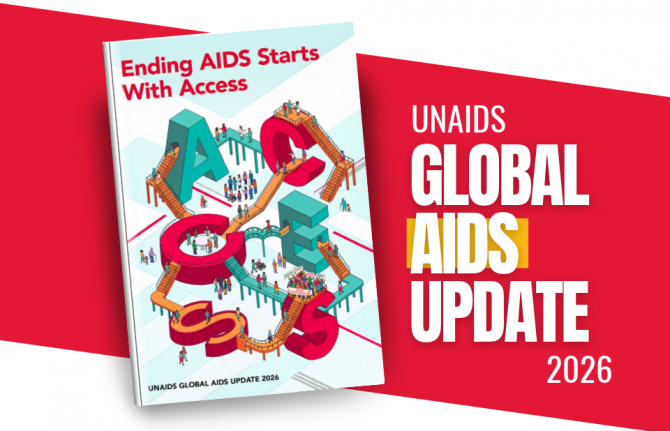
Decades of progress against HIV are at risk because funding cuts and barriers to access are pushing prevention and treatment out of reach, UNAIDS has warned in its annual report.
The report, Ending AIDS Starts with Access, was released ahead of World AIDS Day on 1 December. It finds that HIV funding in low- and middle-income countries fell by more than US$1 billion in 2025, leaving an annual gap of US$4.3 billion to stay on track to end AIDS as a public health threat by 2030.
"The world is sleepwalking into a preventable crisis," said Winnie Byanyima, executive director of UNAIDS.
Prevention is falling first
About 446,000 fewer people were protected by oral pre-exposure prophylaxis (PrEP) in 2025 than a year earlier, across the countries that reported data, UNAIDS says. Only 2.6 million people had access to PrEP in 2025, against more than 20 million estimated to need it.
The largest falls were among key populations. PrEP use dropped by 59% among sex workers, 58% among people who inject drugs, 23% among transgender people and 17% among gay men and other men who have sex with men.
Condom distribution fell from 3 billion to 2.7 billion between 2024 and 2025. Voluntary medical male circumcisions, a key prevention tool in southern and eastern Africa, dropped by 53% across priority countries.
"It is unconscionable that just as the world has breakthrough prevention technologies," funding cuts are putting them out of reach, Byanyima said.
Treatment and testing under strain
About 32.1 million of the estimated 40 million people living with HIV are on treatment, according to the report. But CD4 testing fell by 35% between 2024 and 2025 in six countries studied, and other analyses found viral load testing down by between 16% and 68%.
An estimated 3.4 million people had advanced HIV disease in 2025. One in eight people who presented with advanced disease died within a year, UNAIDS says.
In one study cited in the report, more than three-quarters of civil society organisations reported service disruptions, and more than 80% were working at less than half capacity by the end of 2025. "Community organizations are not an optional extra," Byanyima said.
Africa's exposure
Many African HIV programmes still depend heavily on donors. UNAIDS says external funding makes up about 98% of HIV resources in Nigeria, 94% in Mozambique and 80% in Uganda. Donors pay for all reported prevention spending in Zambia and Eritrea, and for 94% in Namibia and 86% in Malawi.
Domestic HIV spending rose in 55 countries with data. But in many of the hardest-hit countries, debt repayments are two to three times larger than government health spending, the report finds.
UNAIDS says that reaching the 2030 goal could prevent 3.2 million new infections and 1.3 million AIDS-related deaths by the end of the decade.