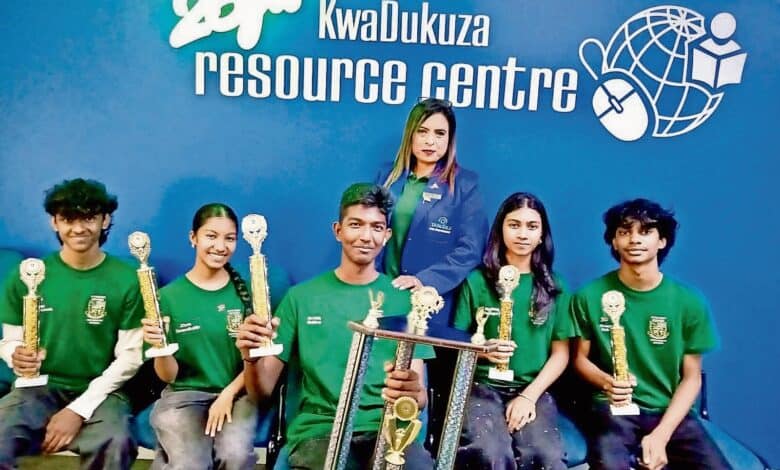
Three South African school teams have reportedly claimed the top three overall positions in the 2026 Tangible World Coding Cup, an international competition that challenges learners to solve problems using practical coding skills.
Stanger Manor Secondary School’s Grade 10 team finished first overall, followed by Hartley Road Primary School in second place and Evergreen Primary School in third, according to the reported competition results.
The event took place on 5 November, bringing together teams from 25 countries. The result is an encouraging achievement for South African schools and a reminder that learners can develop technology and problem-solving skills through practical, collaborative activities.
Learners compete through teamwork and problem-solving
The Tangible World Coding Cup is organised around a hands-on approach to learning. Rather than relying only on traditional computer-based coding, participating teams use physical Tangible pieces to build solutions before testing them through a tournament application.
The challenge requires learners to understand a problem, work together on a sequence of instructions, test their solution and make changes when it does not work as expected.
That process puts problem-solving, logical thinking and teamwork at the centre of the competition.
The reported results indicate that Stanger Manor Secondary’s team completed 30 levels to take the overall title. Hartley Road Primary finished with 28 levels, while Evergreen Primary completed 27.
South African schools also perform strongly in the categories
The reported results show that South African schools performed well beyond the overall rankings.
Hartley Road Primary took first place in the Junior category, with Evergreen Primary in second and Whetstone Primary in third.
In the Senior category, Stanger Manor Secondary finished first. Edgemead High School also placed among the leading teams, finishing third, while an Indonesian school took second place.
The results highlight the contribution of schools and educators who create opportunities for learners to explore science, technology, engineering and mathematics through activities beyond the classroom.
Why access to practical digital skills matters
Digital skills are increasingly important in education and the workplace. Competitions that allow learners to experiment, collaborate and learn from mistakes can help make technology more approachable, particularly for pupils who may not have extensive access to specialist computer facilities.
Tangible’s competition format is designed to make coding accessible through physical learning materials, a device and a team working together. The organiser’s information says schools and learning spaces can participate without requiring teachers to already have a coding background.
The reported South African results are worth celebrating, but they also raise a wider question about how more schools can access similar opportunities.
For now, the three schools’ reported achievement offers a positive example of what learners can accomplish when they are given the chance to practise new skills and compete on an international stage.