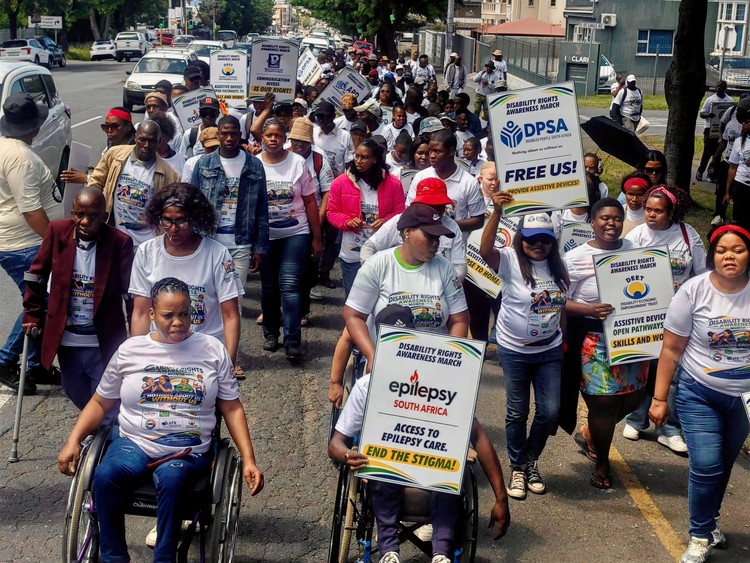
Nokuthula Tsawu did not just join the march. She set out to prove a point, covering the three-kilometre route through KuGompo in her wheelchair alongside hundreds of others on Wednesday, 25 November, who walked, rolled and signed their way to Frere Hospital.
The march, which started at the offices of Disabled People of South Africa, brought together the Deaf Federation of South Africa, the SA National Council for the Blind, REHAB, Autism SA, Epilepsy SA and Down Syndrome SA, among others. Their message was simple: people with disabilities are waiting far too long for the basic tools that let them move, hear, see and work.
Years on a waiting list
"We have a serious problem with the shortage of these [assistive] devices in the province," said Mncedisi Nkotha, the Eastern Cape manager of Disabled People of South Africa. "Some children start schooling very late because they are not getting them in time."
Nkotha said he waited five years for his own prosthetic leg, and that some people wait as long as ten years for a device, which by then may no longer fit their needs and has to be replaced.
Marchers asked for more wheelchairs, prosthetic limbs, walking sticks, hearing aids, spectacles and Braille materials, and for sign language interpreters at courts, police stations, hospitals, schools and other public offices.
Tsawu said people with disabilities are also affected by gender-based violence, and that police stations and hospitals often have no sign language interpreter, making it harder to report abuse or get care. Babalo Bashman, a wheelchair user from Mdantsane, said he has to hire a car to get around because public transport does not accommodate him.
What they asked of the province
The memorandum also called for an end to stigma and discrimination, and for barriers to jobs and economic opportunities to be removed. Marchers asked Eastern Cape Health MEC Ntandokazi Capa to commit to one major outreach campaign in every district each quarter, and to record and report which rehabilitation services were delivered.
Dr Nozipho Jaxa, a manager who oversees provincial hospitals, received the memorandum and said the MEC would respond by 15 January.
A source at Frere Hospital said most assistive devices in the region are made and repaired at the hospital, which means people must travel from their local hospitals for fittings, adding to the backlog.
Why this matters
A wheelchair, a hearing aid or a prosthetic leg is often the difference between going to school, holding a job or getting to a clinic, and staying at home. The marchers' demands are a reminder that disability rights are also about everyday access: a bus you can board, a nurse or police officer you can talk to, and a device that arrives while you still need it.
What we do not yet know
- How many people are currently waiting for assistive devices in the Eastern Cape, and the average waiting time. No official figures were given at the march.
- What the MEC will commit to when she responds by 15 January.